2026-07-14
As humanoid robots accelerate from Proof of Concept (PoC) to mass production and delivery, the importance of underlying control components—such as joint modules, dexterous hands, end effectors, and motor driver boards—is becoming increasingly prominent. These control boards carry massive amounts of MCU programs, communication parameters, and control data, directly determining the robot's motion stability and operational reliability.
During the R&D phase, the core task of programming is simply firmware downloading and prototype debugging. However, as products enter the New Product Introduction (NPI), pilot runs, and mass production, the focus shifts from "whether the program can be flashed" to three critical imperatives: Can the same firmware be programmed stably and repeatedly? How can multiple control board models and various firmware versions be managed? If issues arise later, can they be traced back to the specific board, firmware version, and programming records?
At this stage, MCU programming is no longer just a simple firmware download; it is a crucial step in ensuring version consistency, delivery stability, and issue traceability.
Many robotics companies utilize universal debugging and programming tools such as J-Link, P&E, and ST-LINK during the R&D phase. While these tools are ideal for single-board debugging, firmware downloading, fault isolation, and early Bring-up, their limitations in batch operations, programming stability, speed, and data traceability gradually emerge as projects enter pilot runs and product delivery.
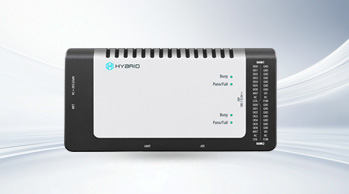
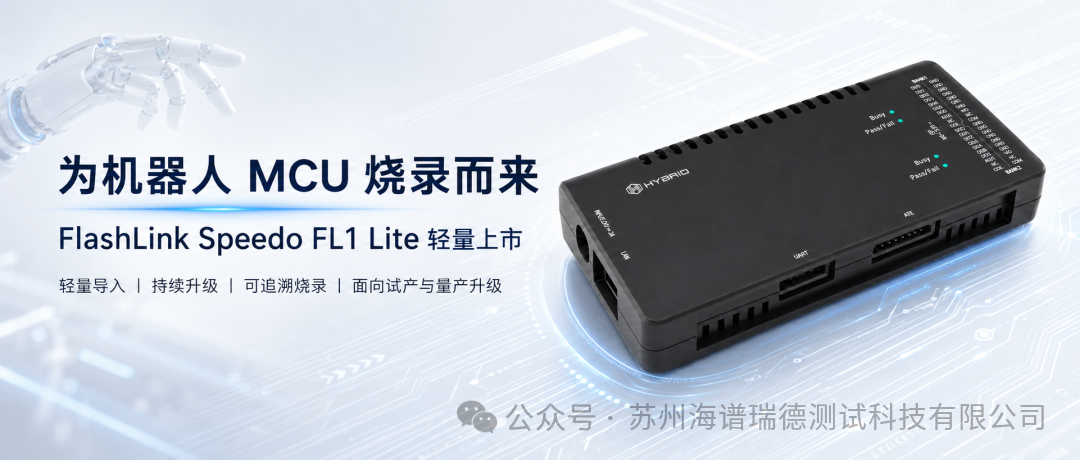
To address this specific challenge, Hybrid Test introduces the FlashLink Speedo FL1 Lite. Rather than being a complex, large-scale automation system, it is a lightweight, high-speed, and user-friendly programmer built on mass-production-grade hardware and software foundations. It serves as the ideal first step for robotics customers transitioning from R&D debugging tools to standardized mass-production programming workflows.
Lightweight Entry, Continuous Capability Upgrades
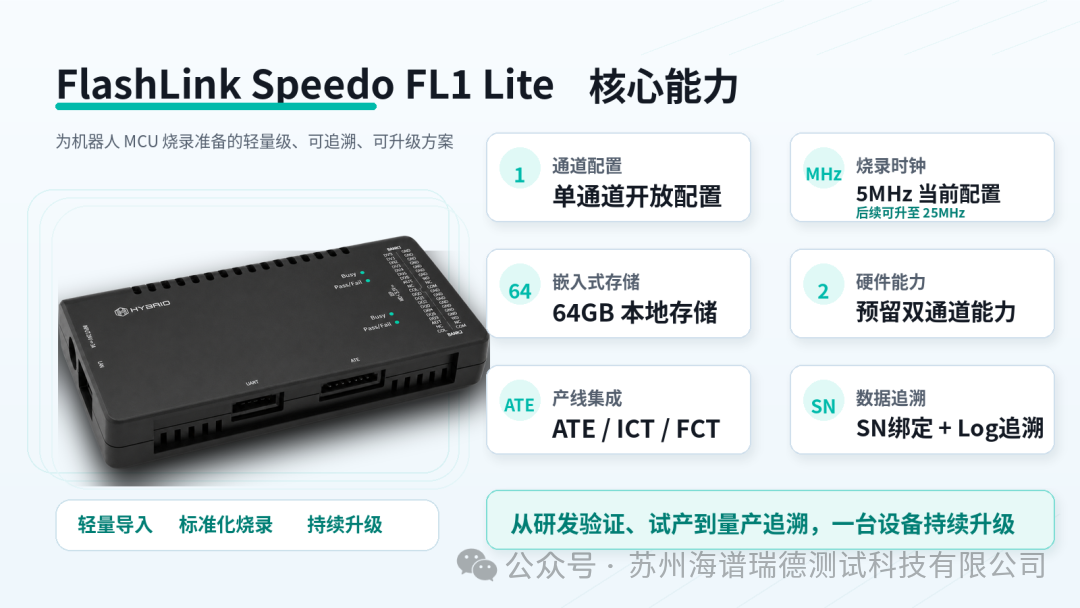
Built on a basic open single-channel configuration, the Speedo FL1 Lite supports a 5MHz programming clock frequency and features 64GB of embedded storage. Its physical and interface design is fully oriented toward smart manufacturing, allowing seamless integration into ATE, ICT, FCT, and other automated testing systems, as well as various production line fixtures.
More importantly, the Speedo FL1 Lite is not a "low-cost, low-spec" product destined for future obsolescence. It has dual-channel capabilities reserved at the hardware level, with the programming clock frequency upgradable to 25MHz in the future.
This means that as projects scale from single-board validation to multi-board parallel production, or when facing stringent cycle time requirements, companies do not need to spend heavily on entirely new hardware. Through remote firmware upgrades, users can unlock higher bandwidth and dual-channel parallel capabilities online. From R&D validation and pilot runs to mass production, a single device can continuously evolve alongside your project.
One Device, Comprehensive Coverage of Mainstream Robot Chip Platforms
While robot control boards may seem complex, they fundamentally rely on three types of chips: MCUs, motor drivers, and automotive/industrial-grade controllers. Currently, mainstream platforms—including ST STM32G4/F4/H7, TI C2000, Infineon AURIX TC2xx/TC3xx/TC4xx, NXP S32K, Renesas RA/RX/RZ, and GigaDevice GD32H75E/GD30DRE518—essentially cover all programming needs for joint modules, dexterous hands, and motor driver boards.
In mass production, the real challenge is not the programming itself, but managing multiple boards, chips, and firmware versions within a single project. The Speedo FL1 Lite is designed precisely for this: mainstream robot MCUs are pre-adapted, and new chips can be rapidly supported on a per-project basis. This allows customers to consolidate a scattered pile of tools into a single standardized device and a unified data system.
From Simple Firmware Downloading to Traceable Programming
In the early stages of a project, programming information might only be saved on an engineer's PC or in local operation logs. However, as control board models multiply and firmware iterations accelerate, tracking which board was flashed with which version, whether it was successful, when it was completed, and which product batch it belongs to becomes increasingly critical. In complex supply chains and production line coordination, the ultimate nightmare is "version mixing" leading to "untraceable field failures."
The FlashLink Speedo FL1 Lite supports barcode scanning to bind board Serial Numbers (SNs), automatically recording board identity, firmware version, programming time, results, and complete logs. Every programming session generates a fully traceable data record. When issues such as version mixing, prototype anomalies, or field failures occur in joint modules, dexterous hand control boards, or actuator driver boards, companies can quickly pinpoint the exact board and firmware version, drastically reducing manual verification and troubleshooting time.
The Programming Foundation Built for Robot Mass Production
The competition in embodied AI takes place not only at the level of large models, algorithms, and whole machines, but also within every single joint, control board, and stable programming cycle. As robots transition from laboratories to real-world applications, the underlying toolchain must evolve from merely "functional" to "stable, reliable, and traceable."
With a lightweight configuration that lowers the barrier to entry for professional programming equipment, and an elastic hardware architecture that grows alongside your enterprise, the FlashLink Speedo FL1 Lite lays the most solid foundational control base for the explosive mass production of the robotics industry.
As humanoid robots accelerate from Proof of Concept (PoC) to mass production and delivery, the importance of underl...
The mass installation and deployment marks the successful entry of our high-end domestic programming equipment into the...
As automotive electronic architectures rapidly evolve toward central domain control, next-generation Central Domain C...